
Free Determiner Finder Tool
Find and highlight determiners in any text with our free online determiner identifier. Instantly spot articles, demonstratives, and quantity words that introduce or clarify nouns. Ideal for students, teachers, ESL learners, and writers reviewing sentence structure.
Try these examples:
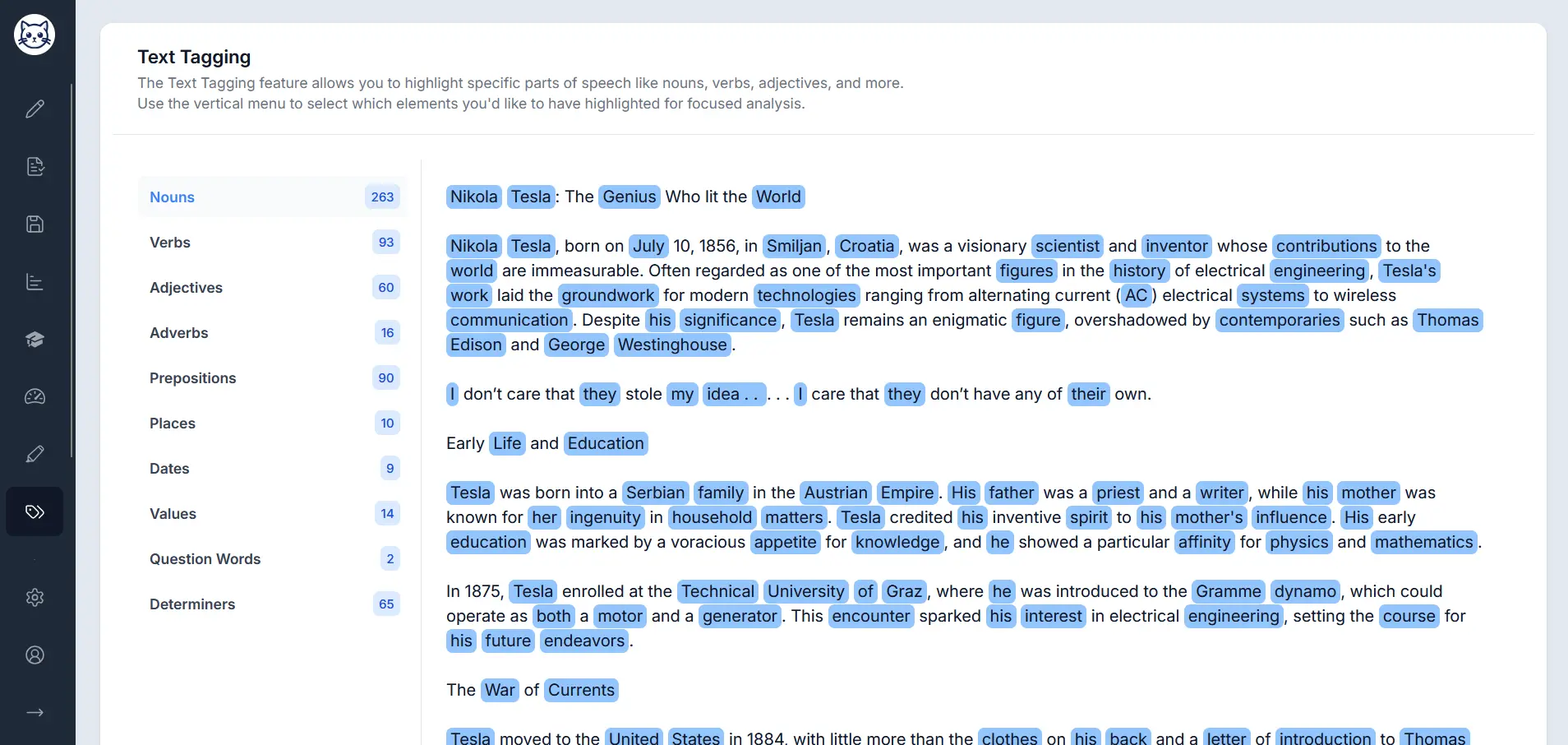
Advanced Parts of Speech Analysis
Go beyond basic determiner detection with Gorby's text tagging feature. Analyze nouns, verbs, adjectives, pronouns, and all parts of speech in one place.
What Are Determiners?
A determiner is a word placed before a noun to show which noun you mean, how many there are, or who owns it. In the book, those ideas, and every student, the words the, those, and every are determiners.
Determiners make a noun phrase more precise. They help readers understand whether you mean one item or several, a particular item or any item, and whether something belongs to someone.
Articles
Point to a noun generally or specifically.
Examples: a, an, the
Demonstratives
Point to particular people, places, or things.
Examples: this, that, these, those
Quantifiers
Tell us about amount, number, or distribution.
Examples: each, every, all, some
Why Find Determiners in Your Writing?
- Improve clarity: Check that readers can tell exactly which noun you mean.
- Review noun phrases: See how specific, general, or limited your references are.
- Build grammar confidence: Practice recognizing how small words shape the meaning of a sentence.
Determiners and Pronouns
Some words can play different grammatical roles depending on the sentence. For example, those is a determiner in “those books,” but it can work as a pronoun in “those are mine.” Use this finder as a quick guide, then read the surrounding words to understand each word’s role in context.
Who Benefits from Our Determiner Finder?
Whether you're learning English, teaching grammar, or polishing a draft, our determiner identifier makes noun phrases easier to recognize and review.
Students
Practice finding the small words that make a noun phrase specific, general, or quantified before submitting essays and grammar assignments.
✓ Identify articles and demonstratives in context
✓ Review noun phrases for grammar exercises
ESL Learners
Build confidence with English word order and learn how articles, this/that words, and quantifiers change the meaning of a noun.
✓ Compare a, an, and the in real sentences
✓ Notice quantity words such as each, every, and some
Teachers
Create quick, visual grammar activities and give learners a way to check their understanding independently.
✓ Prepare examples for lessons on noun phrases
✓ Help learners discuss a word's role in context
Writers and Editors
Scan a draft for wording that may be too vague, overly broad, or inconsistent when referring to people, places, and things.
✓ Check whether references are specific enough
✓ Review consistency in explanatory and instructional writing
Ready to Find Your Determiners?
Join thousands of students, teachers, and writers who use our determiner finder to improve their understanding of grammar and enhance their writing skills.
Try the Determiner Finder ToolWriting with Determiners
Small choices such as a, the, this, and some shape how precise and natural a sentence feels. Use these quick checks while you revise.
Choose Between General and Specific References
Introduce Something New
Use a or an when a singular countable noun is not yet known to the reader.
We found a solution to the problem.
Refer to Something Known
Use the when the reader can identify the particular noun you mean from the context.
The solution worked well for the whole team.
Match the Determiner to the Noun
Singular and Plural Forms
Make demonstratives agree with the number of the noun.
Incorrect: This reports are useful.
Correct: These reports are useful.
Countable and Uncountable Nouns
Use a determiner that works with the kind of noun you are describing.
Incorrect: Much ideas were shared.
Correct: Many ideas were shared.
Possessive Determiners
Possessive determiners show who owns or is associated with the noun. They always appear before the noun and agree with the possessor, not the noun that follows.
Common Possessive Determiners
Example
My report is ready.
Their findings were conclusive.
Note: possessive determiners differ from possessive pronouns (e.g., "mine" vs "my").
Tips for Using Determiners Effectively
Read the Sentence Aloud
If a noun phrase sounds incomplete without a word before the noun, a determiner is likely needed.
Check Reference Clarity
If your reader can't tell which specific noun you mean, swap a general determiner for a specific one.
Match Number and Type
Ensure the determiner fits the noun's countability: use "many" with countable nouns and "much" with uncountable ones.
Watch for Determiner vs. Pronoun
Words like "this" and "those" can be determiners (before a noun) or pronouns (standing alone). Check the word's position.
Practice Spotting Determiners
Read this sentence and identify all the determiners before checking the answer:
"My friend bought a new car, but the engine made a strange noise on its first drive."
Determiners found:
My (possessive), a (article), the (article), a (article), its (possessive)
Tip: Paste this sentence into the determiner finder above to see how the tool highlights each one automatically.
Explore More Grammar & Text Tools
Explore the other parts of speech in your text with these free tools.
Noun Finder
Locate and categorize nouns to analyze the subjects and objects that determiners introduce.
Find NounsPronoun Finder
Identify pronouns and spot words that can function as either pronouns or determiners.
Find PronounsAdjective Finder
Find descriptive words that add detail to the noun phrases in your writing.
Find AdjectivesVerb Finder
Identify action, linking, and auxiliary verbs to analyze the dynamism of your text.
Find VerbsPreposition Finder
Highlight prepositions and prepositional phrases that follow determiners in noun phrases.
Find PrepositionsResources & Further Reading
Explore these grammar guides for more detailed explanations, examples, and practice.
Cambridge Dictionary Grammar
A detailed introduction to determiners, including articles, demonstratives, possessives, quantifiers, and numbers.
Read the Cambridge guide to determiners →British Council LearnEnglish
A beginner-friendly explanation of specific and general determiners, with examples and interactive exercises.
Learn about specific and general determiners →Cambridge Guide to Typical Errors
Review common determiner mistakes, such as using the wrong noun type or combining referring determiners incorrectly.
Review common determiner errors →Ready for Professional Text Analysis?
Take your writing analysis to the next level with Gorby's comprehensive text analyzer. Get advanced features, real-time feedback, and detailed insights into your writing.
Advanced Text Analysis
Complete parts of speech tagging, readability scores, and writing insights
Real-Time Feedback
Get instant suggestions as you type to improve your writing style
Privacy Focused
All analysis happens locally - your text never leaves your device
Free to try • No signup required • Works in your browser