
Free Date Finder Tool
Find and highlight common calendar dates, clock times, relative date phrases, durations, and ranges in your text. The tool recognizes references such as "January 15, 2023," "next Monday," "three hours," and "from 2019 to 2022".
Try these examples:
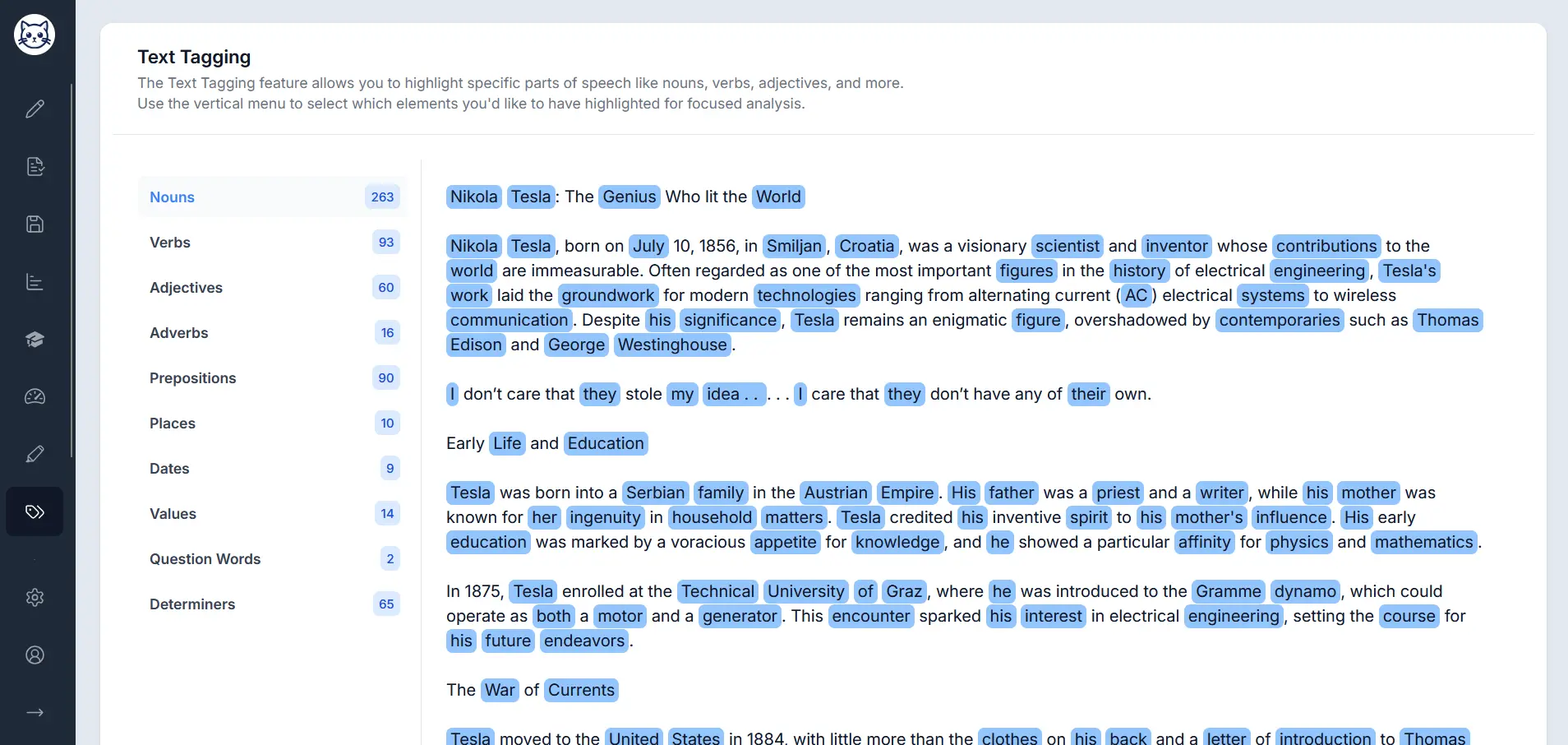
Advanced Parts of Speech Analysis
Go beyond basic date detection with Gorby's text tagging feature. Analyze nouns, verbs, adjectives, prepositions, and all parts of speech with comprehensive statistics.
What Are Dates and Temporal Expressions?
Dates and temporal expressions are words and phrases that refer to time. They range from calendar dates like January 15, 2023 and days of the week like Monday to relative references such as yesterday, next month, and in two weeks. They also include times of day like 3:30 PM and durational phrases like for three hours. Identifying them makes it easier to review how a text communicates sequence and timing.
A temporal expression is a meaning-based category, not a part of speech. Month and weekday names are usually nouns, complete dates can form noun phrases, and words such as yesterday and tomorrow can function as time adverbs. This tool groups those forms together because they all answer questions about when or for how long something happens.
See Cambridge Grammar's overview of time adverbs for examples.
Why Dates Matter in Writing
Temporal expressions anchor writing in time. Whether you are crafting a narrative, reporting facts, or coordinating schedules, they give readers context. Highlighting these references can help you review a document more efficiently:
- Review chronology: Locate the passages that establish sequence, then compare them for consistency.
- Compare repeated references: Find dates, deadlines, and times that may need a manual accuracy check.
- Review research and reporting: Surface time references that may need a citation, source check, or clarification.
- Improve business communication: Gather deadlines, meeting times, and project milestones for a focused review.
Common Types of Temporal Expressions
The finder looks for common English patterns in four broad categories. Because it uses pattern-based language analysis, this is useful coverage rather than an exhaustive list of every possible temporal expression.
Calendar Dates
Specific days, months, and years on the calendar.
Examples: January 15, 2023, 15/01/2023, Dec 25
Relative Dates
Dates expressed relative to the present moment.
Examples: yesterday, tomorrow, next week, last month
Times of Day
Specific clock times and named parts of the day.
Examples: 3:30 PM, noon, midnight, this morning
Durations & Ranges
Durations and expressions with a start and an end.
Examples: for three hours, since 2020, from 2019 to 2022
Quick Tip: How to Find Dates in a Sentence
Spotting temporal expressions becomes easier with a few simple techniques:
- Look for month and day names: Words like January, Monday, or December are strong signals of a calendar date.
- Watch for numbers in date-like patterns: Formats like 12/25/2023, 25-12-2023, or December 25, 2023 are common calendar dates.
- Spot relative time words: Terms like yesterday, tomorrow, next, and last paired with time units (week, month, year) indicate relative dates.
- Use our date finder: Let the tool highlight common temporal references for you to review.
Example Sentence Analysis
"The conference begins on Saturday, March 15, 2025 and runs from 9:00 AM to 5:00 PM each day. Registration opened last month and closes tomorrow."
Saturday, March 15, 2025 = Calendar Date (weekday, month, day, and year)
from 9:00 AM to 5:00 PM = Time Range (start and end clock times)
last month = Relative Date (time interpreted from context)
tomorrow = Relative Date (time interpreted from context)
This example combines a calendar date, a daily schedule, and relative registration references. Highlighting them together makes the timeline easier to review.
What the Finder Does Not Do
The finder identifies likely English time references; it does not validate whether a date exists, resolve relative phrases to a calendar date, or check the facts in your text. For example, it may highlight February 30, 2025 as a date-shaped phrase even though that date is impossible.
Treat the results as a focused review aid. Unusual wording may be missed, and a four-digit number may be highlighted as a possible year when context suggests otherwise.
Who Benefits from Our Date Finder?
Whether you're fact-checking an article, organizing a project timeline, or writing a historical narrative, our date finder helps you locate common temporal references for a closer manual review.
Students & Researchers
Locate historical dates and other time references that may need a source check, citation, or clarification in academic work.
Journalists & Editors
Find likely dates and times in news copy so they can be checked against sources and reviewed for consistency before publication.
Business Professionals
Find deadlines, milestones, and scheduling details in contracts, project plans, and other business documents for a focused review.
Writers & Content Creators
Gather time references from fiction, blog posts, and long-form content so you can compare them and investigate possible timeline contradictions.
Ready to Find Dates in Your Text?
Join thousands of users who rely on our date finder to identify temporal expressions and improve their writing accuracy.
Try the Date Finder ToolWriting Effectively with Dates
Dates are more than just calendar references — they shape how readers understand time, sequence, and context. Clear, consistent date usage makes your writing more professional and trustworthy.
Date Format Consistency
Different style guides recommend different date formats. AP style uses "Jan. 15, 2023," while Chicago uses "January 15, 2023." Choose the convention required by your publication or audience and apply it consistently. Unexplained switching between "15 January 2023" and "January 15, 2023" may distract readers.
Common style guide preferences:
References: Cambridge Grammar on dates and ISO 8601.
Avoiding Ambiguous Dates
Numerical date formats can be ambiguous. Does 01/02/2023 mean January 2 or February 1? The answer depends on where your reader is from. In international or online writing, spell out the month or use an unambiguous format like ISO 8601 (YYYY-MM-DD) to eliminate confusion.
Ambiguous:
01/02/2023, 02/03/24, 3/4/2025
Could mean different dates depending on locale.
Clear:
January 2, 2023, 2023-01-02, 2 Jan 2023
Less likely to be misread across English-speaking locales.
Temporal Clarity in Narratives
When writing stories, blog posts, or reports, maintaining a clear timeline is essential. Readers should never have to backtrack to figure out when events happened relative to each other. Avoid vague phrases like "recently" or "a while back" when precision matters. The date finder can gather many of the references, but you still need to compare and interpret them.
Watch out for timeline contradictions:
"She graduated in 2018, two years before she began university in 2020." — The sequence is impossible as written.
Be specific with relative dates:
Instead of "The report is due soon," write "The report is due by Friday, March 15."
Explore More Grammar & Writing Tools
Improve your chronological precision, clarity, and overall writing with our full suite of free text analysis tools.
Reading Time Calculator
Estimate how long your text takes to read based on average reading speeds.
Calculate Reading TimeAdjective Finder
Locate all adjectives to enhance descriptive language and text vividness.
Find AdjectivesKeyword Density Calculator
Analyze keyword frequency and distribution for SEO and content optimization.
Calculate DensityFlesch-Kincaid Grade Level
Convert text complexity into US grade levels to assess content accessibility.
Calculate Grade LevelReady for Professional Text Analysis?
Take your writing analysis to the next level with Gorby's comprehensive text analyzer. Get advanced features, real-time feedback, and detailed insights into your writing.
Advanced Text Analysis
Complete parts of speech tagging, readability scores, and writing insights
Real-Time Feedback
Get instant suggestions as you type to improve your writing style
Privacy-Focused
All analysis happens locally — your text never leaves your device
Free to try • No signup required • Works in your browser