Find the paragraphsyour readers struggle with
One dense paragraph can lose a reader halfway through your piece. Gorby scores every paragraph with the Flesch Reading Ease formula and highlights the ones that are hard to read.
Included in every paid plan Web and Windows app Flesch Reading Ease scores
 Policy update - Gorby
Our new hybrid work policy
Following last year's restructuring, management has decided on a standard hybrid working arrangement for all eligible staff, regardless of department. It is considered the most appropriate way to balance operational continuity with individual flexibility.
If you would like to work from home on extra days, please submit a request through the internal portal, including a brief explanation and the expected duration, so that your manager can review it.
The office stays open every day. Desks are first come, first served. If you have questions, ask your manager or email the people team.
Paragraph Readability
Identifies paragraphs that may be difficult to read
Found 2 paragraphs that may be difficult to read.
1 very difficult, 1 difficult
Very Difficult Paragraph
Score: -2.0 - Extremely Difficult
"Following last year's restructuring, management has decided on a..."
This paragraph is very difficult to read. Consider breaking it into shorter sentences and using simpler words.
Difficult Paragraph
Score: 42.9 - Difficult
"If you would like to work from home on extra days, please submit..."
This paragraph is difficult to read. Consider breaking it into shorter sentences and using simpler words.
Scores use the Flesch Reading Ease formula. Higher is easier.
Try it: click a highlighted paragraph or press Select Paragraph, then rewrite it and watch the score change.
How it's scored
Shorter sentences, shorter words, higher score
The Flesch Reading Ease score looks at two things: how long your sentences are and how many syllables your words have. Scores usually run from 0 to 100, and higher is easier.
Length alone doesn't make text hard. Try the quick test and see which version of each message scores higher.
Which one would score higher?
Pair 1
Same message, shorter words.
Pair 2
More words, but shorter sentences and simpler ones.
Why paragraphs get hard to read
- Sentences that keep going One idea leads to the next, joined by commas and "and", until the sentence runs 40 words.
- Formal words "Utilize", "facilitate", "subsequently": long words add syllables without adding meaning.
- Verbs turned into nouns "Make a determination" instead of "decide" makes every sentence longer and heavier.
- Writing for insiders Text written for experts gets read by everyone, and newcomers lose the thread.
How it works
Three steps to easier reading
- 1
Run the check
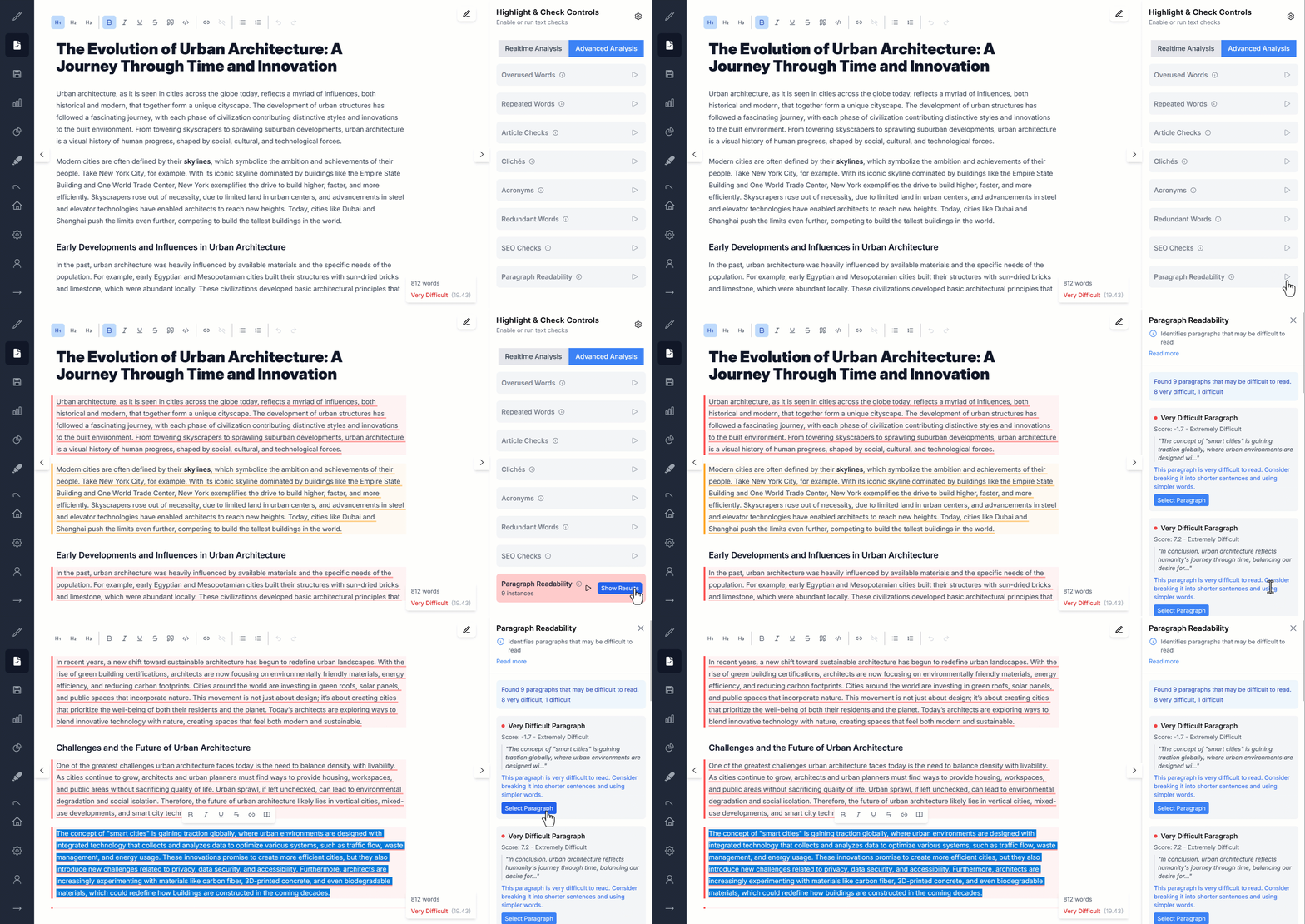
Open the Advanced Analysis tab in the Highlight & Check Controls panel and press play next to Paragraph Readability.
- 2
See the hard paragraphs
Difficult and very difficult paragraphs are highlighted in two colors, and the panel shows how many of each it found.
- 3
Select and rewrite
Click Show Results to see each score and a preview. Press Select Paragraph, then split long sentences and swap in simpler words.
What you get
Know exactly which paragraphs to fix
An overall score tells you something is wrong. Paragraph Readability tells you where.
Scored paragraph by paragraph
Every paragraph gets its own Flesch Reading Ease score, so one dense paragraph can't hide behind an easy average.
Two levels of difficulty
Very difficult paragraphs (under 30) and difficult ones (30 to 50) are highlighted in different colors.
The exact score
Each result shows the score with a label, like "Score: 7.2 - Extremely Difficult".
A preview of each paragraph
The first words of every flagged paragraph help you recognize it before you jump there.
Advice you can act on
Each result tells you what to do next: break it into shorter sentences and use simpler words.
Select the whole paragraph
Select Paragraph highlights the full paragraph in your text, ready to be rewritten.
Make it yours
Two levels, two colors
Very difficult and difficult paragraphs each have their own highlight color, so you can tell at a glance which ones need the most work.
- Highlight color for very difficult paragraphs (below 30)
- Highlight color for difficult paragraphs (30 to 50)
Settings
Changes are saved automatically.
Very Difficult Paragraphs
Highlights paragraphs with a Flesch score below 30
Highlight Color
Difficult Paragraphs
Highlights paragraphs with a Flesch score between 30-50
Highlight Color
In accordance with the aforementioned considerations, implementation is deferred.
We will start once the budget for the new tools is approved.
Click a color to see how a different highlight looks.
The Flesch Reading Ease scale
Gorby flags paragraphs under 50. For a general audience, aim for 60 or higher.
- 0–30
- Very difficult
- Flagged
- 30–50
- Difficult
- Flagged
- 50–60
- Fairly difficult
- 60–70
- Plain English
- A good target for most readers
- 70–100
- Easy
Keep polishing
Pairs well with
Readability Metrics
Scores your whole text with formulas like Flesch-Kincaid, Coleman-Liau, and Dale-Chall.
Learn moreSEO Checks
Reviews your headings and title length so search engines can follow your structure.
Learn moreRedundant Words Detection
Spots phrases like "end result" that say the same thing twice.
Learn moreCliché Detection
Flags tired expressions that readers have seen too many times.
Learn moreFAQ
Common questions
Want to dig deeper into the formula? Read our guide to the Flesch Reading Ease formula. Still have a question? Email us at contact@gorby.app.
- What is the Flesch Reading Ease score?
- A readability formula that looks at two things: how many words your sentences have and how many syllables your words have. Scores usually fall between 0 and 100, and higher means easier to read. Short sentences and short words push the score up.
- Which paragraphs does Gorby flag?
- Paragraphs that score below 50. Those under 30 are marked very difficult, and those between 30 and 50 are marked difficult, each in its own color.
- What score should I aim for?
- For a general audience, 60 or higher is a good target. Technical, legal, and academic writing often scores lower, and that can be fine when your readers are experts. What matters most is that no single paragraph is much harder than the rest.
- How do I make a paragraph easier to read?
- Split long sentences into shorter ones, swap long words for everyday ones ("use" instead of "utilize"), turn nouns back into verbs ("decide" instead of "make a decision"), and keep to one idea per paragraph.
- Why score each paragraph instead of the whole text?
- An average hides the problem spots. A text can score well overall and still have one paragraph that loses readers halfway through. Scoring paragraph by paragraph shows you exactly where to start.
- How is this different from Readability Metrics?
- Readability Metrics scores your whole text with several formulas, like Flesch-Kincaid and Coleman-Liau. Paragraph Readability uses the Flesch Reading Ease score to point to the specific paragraphs that need work.
- Is Paragraph Readability included in the free plan?
- Paragraph Readability is one of the Advanced Analysis checks, which come with every paid plan. The free plan includes real-time checks like hard-to-read sentences and passive voice.
- Does it work in the desktop app?
- Yes. Paragraph Readability works the same way in the web app and the Gorby desktop app for Windows. With a plan, Pro checks stay unlocked for up to 5 days offline.
Make every paragraph easy to follow
Run Paragraph Readability on your next draft and fix the paragraphs that slow readers down.